


What’s News?
Pry Bars and their uncanny resemblance to bin chickens

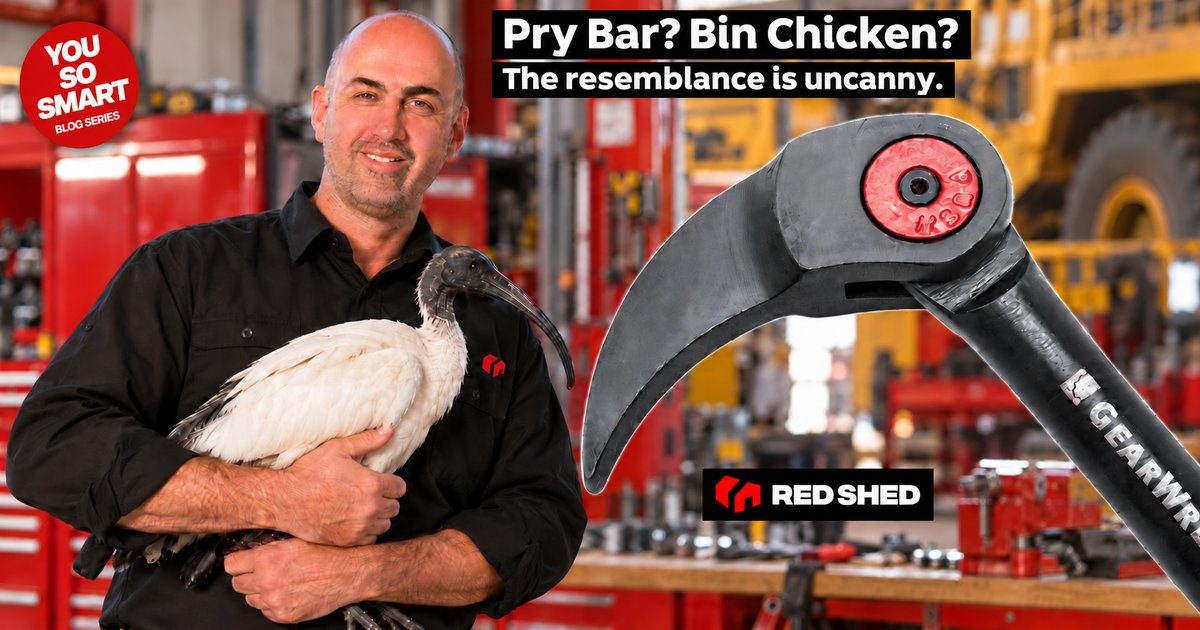
Have a look at a GEARWRENCH indexing pry bar.
The long neck. The curved beak. The knack for getting into awkward places.
Once you see the resemblance, you’ll never unsee it.
Nature gave the ibis a curved beak for fossicking around in awkward places.
GEARWRENCH arrived at a similar-looking solution for fitters.
One’s retrieving your sandwich. The other’s helping you find a workable angle around a chassis rail.
The workshop version has an extra trick - an adjustable head that locks into position.
On the 33-inch GEARWRENCH model, that means 14 locking positions through 180 degrees, with a smooth head profile designed for restricted access.
My feathered apprentice can turn his head too. So far, he’s only used that feature to locate unattended food.
A fixed pry bar gives you one working angle. Sometimes it’s spot on. Sometimes you get the tip into the gap and discover the handle needs to go straight through a neighbouring component.
That’s when the language starts.
An indexing head lets you change the angle between the tip and the handle. You can find a position with secure contact, useful clearance and room for a controlled movement.
It gives you more options before you disappear behind the toolbox looking for a differently shaped bar.
The lifting gear has done the heavy work. The component is supported. Everything is almost where it belongs.
Almost.
The holes are looking at each other, but they’re refusing to commit.
Depending on the equipment and its maintenance procedure, a suitable pry bar can help with aligning brackets and steel assemblies, making small adjustments before fitting fasteners.
It can also help position supported components, nudging an assembly into place while suitable lifting equipment carries its weight.
And when surrounding structure gets in the way, adjusting the head can give the handle room to move.
GEARWRENCH identifies aligning steel, repositioning equipment and moving engines among its intended applications. These are examples of how those uses can translate to workshop work; suitability depends on the particular job.
Small, controlled movements. Patience. Occasionally some negotiation.
Much like getting my new pet out of the crib room.
Same frustrations, different machinery.
You might be positioning a fabrication assembly, working around a machine base or helping settle supported equipment into place during installation.
The adjustable head gives you another angle when the fixed bend on an ordinary bar leaves the handle somewhere unhelpful.
Look for a tip that seats properly and a contact surface that can take the force without damage. If either is questionable, change the setup.
More enthusiasm won’t improve a poor contact point. Neither will the bloke beside you saying, “Give it a bit more.”
I reckon these bars have opened a tinny or two when other appropriate tooling wasn’t available, too. We’ll file that under workshop folklore. Use a proper opener. The bin chicken has enough bad habits already.
Choose the size for the available space and the movement required.
A smaller bar can be easier to position in confined access. A longer bar offers more reach and leverage, but needs room for the handle to move.
Ask RED SHED about:
Buying the longest one because it looks impressive is how you end up with a tool that won’t fit where the job is.
The eight-inch one also needs watching. Small enough to lend someone. Apparently too small for them to remember returning.
Make sure the indexing head is securely locked before applying force. Seat the tip properly, keep fingers clear of pinch points and consider where the tool and component will move if contact slips.
Follow the machine’s isolation and maintenance procedure, with appropriate lifting and support equipment in place.
A positioning tool should never be the thing keeping a heavy component off someone.
That peculiar-looking head earns its place by giving you a choice of working angles.
For fitters and maintenance crews dealing with awkward access, that means more ways to position the tool before applying force. Match the size to the job, check your contact points and keep the movement controlled.
As for my alleged penchant for bin chickens? I appreciate anything that turns up every day with that much determination.
I’d appreciate it more if it brought its own lunch.
These pry bars sell fast.
Call 1800 330 318 or email sales@redshed.au to check available sizes before heading in. You’ll find us at 8 Industrial Drive, Emerald.
Ask for an indexing pry bar.
You’ve read the article. You’ve met my alleged pet. Now let’s find out whether anything stuck.
Can you tell your indexing head from your ibis? Do you know which bar belongs in a tight spot, and which bird’s been through your lunch?
Have a crack at our workshop quiz. No trade certificate on offer, but bragging rights in the crib room are absolutely up for grabs.
Get them all right and you’re officially smarter than Craig’s bin chicken.
Get them wrong and he’d still like to discuss an apprenticeship. Bring sandwiches.
You So Smart · Workshop quiz
First things first. Which workshop freeloader does an indexing pry bar look like?
What does “indexing” actually mean on a pry bar?
How far does the head on a GEARWRENCH indexing pry bar swing, and how many places will it lock?
You need a different angle. What do you do before you adjust the head?
Which of these does GEARWRENCH actually list as an intended use?
You're nudging a heavy assembly into place. What should be carrying its weight?
The tip won't seat properly and the contact surface looks dodgy. Best move?
Why not just buy the 33-inch and use it for everything?
The little 8-inch (82208) has an old-school side hustle in the auto workshop. What is it?
Last one. What are these GEARWRENCH bars made of, and what finish do they wear?
0/10
Ready for the real thing? GEARWRENCH 8-inch (82208), 24-inch (82224) and 33-inch (82233) indexing pry bars at RED SHED, 8 Industrial Drive, Emerald. Check sizes before you head in.
Cheers,
Craig
RED SHED. Keeps you going.
A pry bar with a head that swings to different angles and locks in place. On GEARWRENCH indexing pry bars, the head rotates through 180 degrees with 14 locking positions, so you can find a working angle in tight spots instead of hunting for a differently bent bar.
Match it to the space and the movement. The 8-inch (82208) is easiest to position in confined access. The 24-inch (82224) and 33-inch (82233) give more reach and leverage, but need room for the handle to move.
No. Suitable lifting and support equipment should carry the weight. A pry bar is for small, controlled positioning movements, and should never be the thing keeping a heavy component off someone.
Alloy steel with a black phosphate finish. GEARWRENCH rates them to meet or exceed ANSI and ASME strength requirements.
Based in Emerald, QLD, Red Shed Industrial Supplies stands as the leading authority in mining, earthmoving, and industrial supplies, ensuring that businesses obtain top-tier products for their operations. Our comprehensive range encompasses high-quality mining gear, durable earthmoving machine supplies, PPE, consumables, essential spare parts, and specialised tools that are designed to augment the efficiency of your onsite projects and 24/7 operations. With a reputation for unparalleled product expertise, we're committed to offering priority service and competitive pricing.
Unlock Exclusive Benefits. Elevate your business experience with our VIP Account. APPLY TODAY.
Get access to priority service, unparalleled expertise, and special offers tailored just for you.


