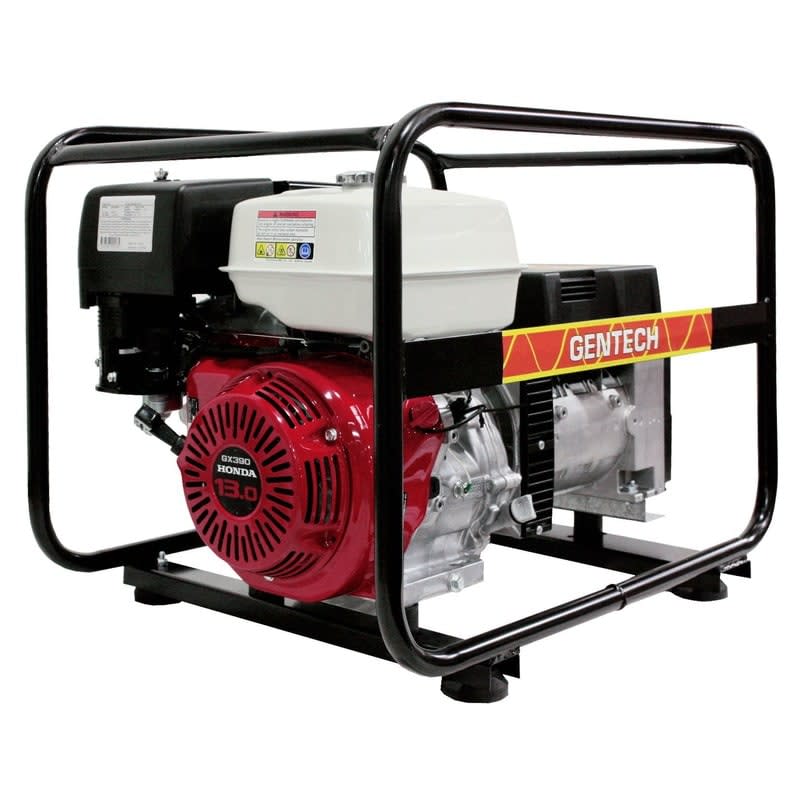
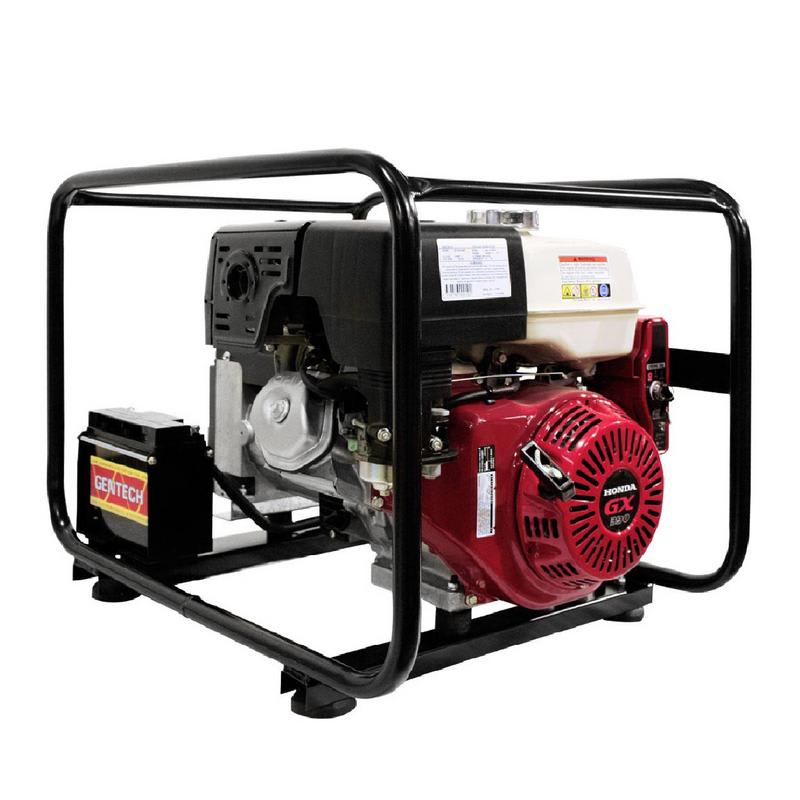
Respect and understand the power of your generators.
Because undersized power quietly kills tools. And they've got a pretty cool history. Read on.
With industrial hand on industrial heart, I personally, deeply feel generators don’t get much respect.
Sad, really.
On most sites, they’re treated like a necessary nuisance — loud, smelly, parked somewhere out of the way.
I've often felt this way myself at RED SHED HQ.
Respect, please.
Because when the grid disappears — storms, shutdowns, remote jobs — that smelly nuisance suddenly becomes the most important piece of equipment on site.
Without it, nothing else works.
And the smart, nerdy interesting bit?
The basic idea behind that machine hasn’t really changed in nearly 200 years. We’ve just got a lot better at packaging it for real work.
The 200-year-old rule that still powers your site
A bitta history so you can sound smart at little lunch.
In 1831, Michael Faraday figured out a rule that still runs the show: motion + magnetism = electricity.
He demonstrated electromagnetic induction (moving a magnet through a coil generates current), and then built an early generator concept to prove the relationship between magnetism and motion.
He also built the Faraday disc (a homopolar generator). It wasn’t practical, and it didn’t make huge usable power — but it proved the point that mechanical motion can be converted into a continuous electrical output.
Despite every innovation since, we still haven’t found a better core method of producing serious power than Faraday’s fundamental trick — turning motion into electricity. Whether the motion comes from a diesel piston, a wind turbine, or a hand crank, the physics is the same.
Old-school. Still undefeated. My kinda tech.
The accidental revolution. The day a generator became a motor
Fast-forward to 1873, Vienna Exhibition.
Zénobe Gramme developed a dynamo design that produced a much smoother output than earlier machines. And then his partner, Hippolyte Fontaine, accidentally connected two machines with a long cable.
The second machine started spinning — basically revealing that the system was reversible. A generator could become a motor. Power could be generated in one place and used elsewhere.
That moment sounds nerdy. But it was massive.
It’s the point where “power” stopped being tied to the tool, the engine, or the location — and became something you could send where you needed it.
That’s the modern remote worksite right there.
Why diesel buried steam
Before internal combustion took over, “portable power” wasn’t what you’d think it was. A lot of early site power was steam-based and bulky — moving it was a mission.
Then Rudolf Diesel arrives, late 1800s, and the compression-ignition idea starts winning because it’s more efficient and better suited to heavy-duty power generation.
The first diesel engine prototype is commonly dated to 1897.
Why diesel became the workhorse is simple...
- Energy density (diesel carries a lot of energy per litre)
- Practical refuelling
- Better for continuous-duty work
For context, a “diesel gallon equivalent” is often quoted at around 128,700 BTU.
This is why job sites didn’t have to move towards power anymore. Power could come to them.
The “slow kill”. Why your generator might be murdering your tools
Now we get to the bit that matters in the real world.
Most generator failures aren’t dramatic.
They don’t explode. They don’t catch fire. They don’t die heroically.
They just quietly kill your equipment.
Anything with a motor — compressors, pumps, welders, grinders — pulls a surge when it starts.
If your generator doesn’t have enough headroom, that surge causes a voltage dip.
The tool often still runs. So you think you’re fine.
But the motor runs hotter than it should, windings take a beating, and over time, you get that fun mystery cycle
“FFS! Why do tools keep dying on this site?”
Undersizing doesn’t always fail loudly.
It fails slowly.
This is why an 8kVA generator isn’t “overkill” for something that looks like a 4kVA load on paper.
Where “solar generators” fit (and where they don’t)
You’ll hear the term solar generator thrown around a lot lately, but — most of them aren’t generators at all. They’re batteries with inverters that store power, usually charged by solar panels or the grid.
They’re brilliant for lights, comms, laptops and light-duty use, and they’re dead quiet doing it. Where they fall over is continuous motor loads and startup surge — the exact stuff that breaks undersized generators.
That’s why they work best as part of a hybrid setup - solar charging a battery, the battery handling peaks, and a proper generator stepping in when real work starts.
Storage is useful. Generation is still essential. Different jobs, different tools.
Simple generator load guide
This isn’t a spec sheet. It’s a common-sense guide to what catches people out. ALWAYS refer to the expertise of your onsite engineer
| Tool / Use case |
Typical load |
Startup surge |
Reality check |
| Angle grinder (5–7”) |
~1–2 kVA |
Low |
Usually fine solo |
| Circular saw |
~2 kVA |
Medium |
Startup dip on smaller generators |
| Small air compressor |
~3 kVA |
High |
Motor surge causes stalling / voltage drop |
| Welder (entry–mid range) |
~4–6 kVA |
High |
Can hate unstable output |
| Multiple tools running |
Adds up fast |
Compounds |
This is where undersized generators fall over |
*Indicative values only. Actual loads vary by tool brand, condition and how it’s used.
Figures are indicative only and provided as a general guide — always allow headroom and consult a qualified professional for critical or permanent power setups.
The “silent” revolution. Generators are getting seriously engineered
The old stereotype is a generator is a noisy, smelly box.
That’s changing fast.
Modern enclosed generator sets can be designed for noise-sensitive environments using proper acoustic enclosures, airflow management, and serious exhaust silencing. Some Tier 4 sound-enclosed units are designed to achieve ~75 dB(A) at 7 metres (industry-standard measurement).
And here’s why that matters. In perceived loudness, a change of about 10 dB is often described as “sounds roughly twice as loud” (rule of thumb), so noise reductions aren’t linear — they’re meaningful.
So yer, generators are still generators… but they’re also becoming sophisticated “energy systems”, not just angry lawnmowers with a plug on them.
The zero-emission direction is real
Now for the forward-looking bit.
Hydrogen internal combustion engines (H2ICE) are being developed as a “drop-in style” concept for duty cycles where batteries alone can be awkward — especially on remote sites, for continuous loads, or for jobs where charging time is the killer.
JCB has publicly pushed this idea hard, including the concept of pairing hydrogen generators with battery power packs to form on-site microgrids. Their point is simple. The generator becomes a high-efficiency charger, and the battery handles peaks.
That’s not sci-fi. That’s where I've heard a chunk of the industry is heading.
Where does this land for normal humans on real sites
All of the history is cool. But the takeaway is practical.
Generators didn’t just “make electricity portable.”
They made work portable.
The biggest mistake people make isn’t buying a generator that’s “too big”.
It’s buying one that’s just big enough on paper, then acting surprised when tools run hot, stall, or mysteriously die later.
This is precisely why units like the TradePower 8kVA Generator exist — for usable, stable site power with enough headroom for real-world startup demand.
The You So Smart takeaway
Generators aren’t just noisy boxes that keep the lights on.
They decide...
-
- How long do your tools last
- How smoothly your site runs
- Whether power is helping… or hurting your tools and operation
So next time someone says,
“Power’s power, mate”
You’ll know better.
Because you read this. Because you sooooo smart.
OK. Back to school and work now.
Cheers - Craig.
Disclaimer: Compliance note
This article discusses generator capacity and usage concepts only and does not replace site-specific electrical compliance requirements under Australian Standards.